Larger aluminium support disc placed to spread the load.
Tuesday, 8 October 2013
cracks spring support plate
after the tilburg speed trials and trip back home over sharp speed bumps, cracks appeared at the place of the support rings for the compression springs. Not surprisingly where the load acts perpendicular to the fibres of the glass reinforcement.
Saturday, 21 September 2013
A post from Italy
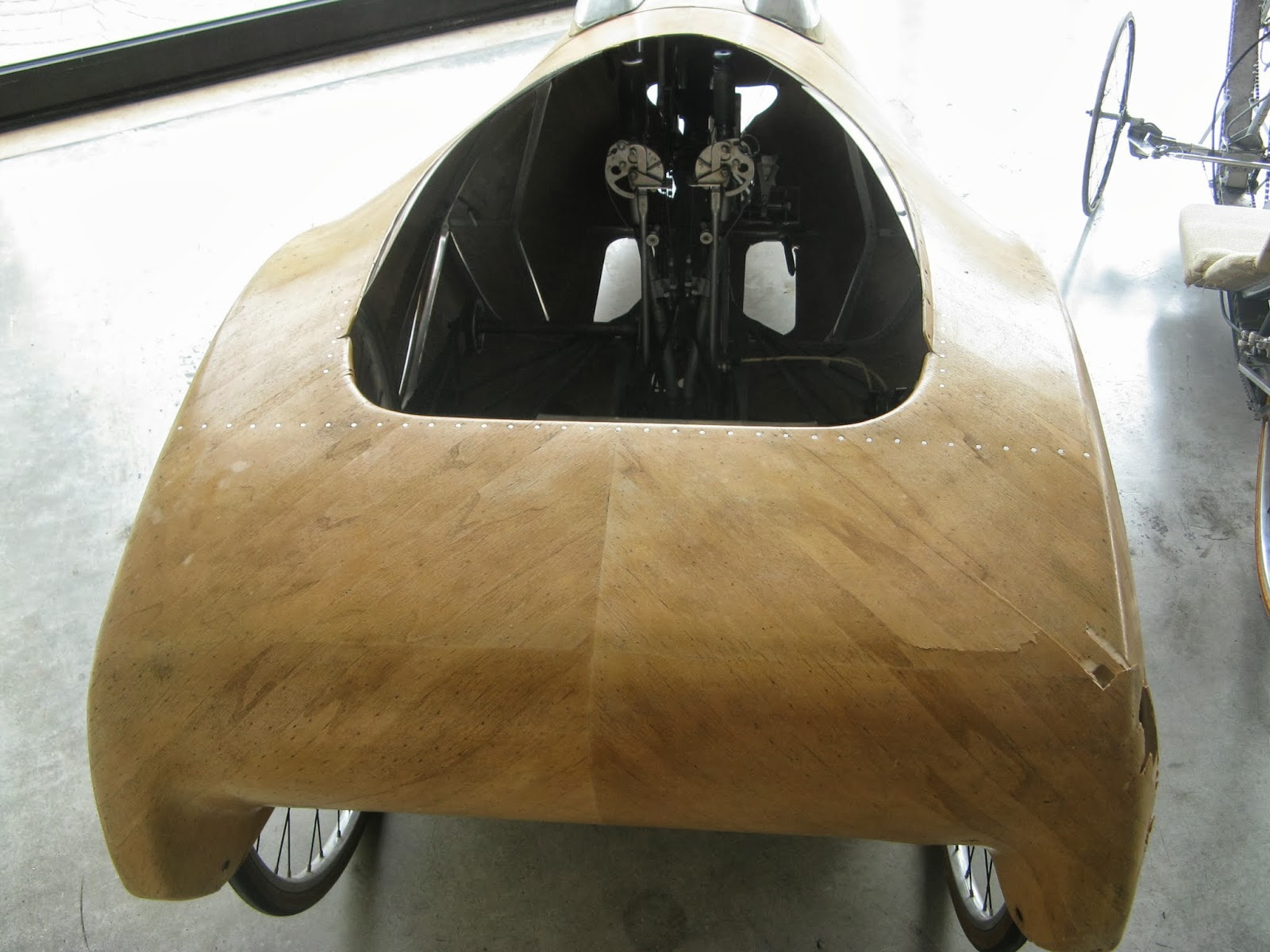
Remigio Maladino mailed me some interesting pictures of a plywood velomobile:

He writes: "All three vehicles (one velomobile, one trike without fairing but quite interesting for the very accurate construction, and an original plane-bycicle toy made during the fascist period) in the pictures are currently for sale in a carrozzeria in my town, Treviso. Only for my curiosity I asked about prices at the beginning of Summer. The owner said he paid nearly 20.000 euro for the lot. I don't know if I had to believe it or not and in any case I was not at all interested in buying it, I was only very interested about the peculiar shape and especially about the technical solutions of the two trikes: The one I sent you the first pictures is very interesting, I suppose also for you for the fact that the wood body was surely built around a former, a shape with different layers of veneered wood, not plywood like your velomobile. In this way it was possible to have double curved sheets but at the price of a much higher quantity of work.
It was interesting for me to see that you had the privilege of working and developing the Alleweder. I agree with you when you say that the great success of the diy kits was probably due to the self satisfaction that may derive to build your own velomobile. In addition to that there is alsothe fact that it can be forwarded all over the world with three boxes, or like some say that it can be easily Ups-able!
The wooden velomobile in the picture as i already told you was built by an independent mechanical engineer - sorry I forgot the name at the moment (will probably ask it tomorrow and let you know more) in the Torino area in the seventies. In the other pictures you can spot the engineer with the famous, at least for me -and at that time younger- designer Giorgetto Giugiaro (VW Golf, Fiat Panda, Fiat Punto etc)."
I like the craftmanship of this machine. It must have taken a tremendous effort to design and built it. The design was made in the 70-ties but it associate it with the 30-ties. Before Dupont and the like developed glass fiber reinforced polyester. It shows some resemblance with the work of Harald Winkler.
He writes: "All three vehicles (one velomobile, one trike without fairing but quite interesting for the very accurate construction, and an original plane-bycicle toy made during the fascist period) in the pictures are currently for sale in a carrozzeria in my town, Treviso. Only for my curiosity I asked about prices at the beginning of Summer. The owner said he paid nearly 20.000 euro for the lot. I don't know if I had to believe it or not and in any case I was not at all interested in buying it, I was only very interested about the peculiar shape and especially about the technical solutions of the two trikes: The one I sent you the first pictures is very interesting, I suppose also for you for the fact that the wood body was surely built around a former, a shape with different layers of veneered wood, not plywood like your velomobile. In this way it was possible to have double curved sheets but at the price of a much higher quantity of work.
It was interesting for me to see that you had the privilege of working and developing the Alleweder. I agree with you when you say that the great success of the diy kits was probably due to the self satisfaction that may derive to build your own velomobile. In addition to that there is alsothe fact that it can be forwarded all over the world with three boxes, or like some say that it can be easily Ups-able!
The wooden velomobile in the picture as i already told you was built by an independent mechanical engineer - sorry I forgot the name at the moment (will probably ask it tomorrow and let you know more) in the Torino area in the seventies. In the other pictures you can spot the engineer with the famous, at least for me -and at that time younger- designer Giorgetto Giugiaro (VW Golf, Fiat Panda, Fiat Punto etc)."
I like the craftmanship of this machine. It must have taken a tremendous effort to design and built it. The design was made in the 70-ties but it associate it with the 30-ties. Before Dupont and the like developed glass fiber reinforced polyester. It shows some resemblance with the work of Harald Winkler.
Friday, 6 September 2013
wedstrijd tilburg
September 1st, a competition with other recumbents. The ride to the track and the competition itself were a very good test for the front suspension. The bike did very well and handled very good. At the end I was confident enough to go flat out.
I noticed that the right side suspension works perfectly as expected, but the left side is stuck. A little work needed.
I've made a video of the competition day: http://youtu.be/kJHP4ILLQwc
I noticed that the right side suspension works perfectly as expected, but the left side is stuck. A little work needed.
I've made a video of the competition day: http://youtu.be/kJHP4ILLQwc
Tuesday, 20 August 2013
Installing front suspension
![]() |
| After machining 4 aluminium discs that keep the metal springs aligned the front suspension was re-installed. |
Maybe you'd like to meet me? Come to the cycling track in Tilburg september 1st, where a recumbent meeting will be held.
Tuesday, 16 April 2013
Rolling again
Joost repaired the body and mounted the wheels again
| The 1.5 mm plywood is now sandwiched between glass fabric reinforced epoxy. |
| Wheel suspension in place. The nylon ball joints are very light but are they reliable? One can see here there is no beam parallel to the chain. It is the monocoque that takes the load. |
Saturday, 30 March 2013
Laminating the wheel box
Joost has laminated the heavy loaded parts of the wheel box on both sides. He used 160 grams glass fabric ('keper') and epoxy resign. By applying glass on both sides of the plywood Joost has created a sandwich panel: Very strong stiff, and light. I like the idea that we can reinforce heavy loaded parts of the body in this very simple and effective way.
I think Joost will get the plywood velomobile on the road next week! I have bought a QuestXS and we plan to compare the aerodynamics of both velomobiles. For me the QuestXS is a very nice alternative for commuting. The shape is very nice but she is rather heavy (34 kg). I wonder how much less the aerodynamics of the plywood velomobile is. The plywood velomobile weighs 23 kg only.
Developing the plywood velomobile is a lot of work. I try to involve others into the project. Let me know if you are interested.
I think Joost will get the plywood velomobile on the road next week! I have bought a QuestXS and we plan to compare the aerodynamics of both velomobiles. For me the QuestXS is a very nice alternative for commuting. The shape is very nice but she is rather heavy (34 kg). I wonder how much less the aerodynamics of the plywood velomobile is. The plywood velomobile weighs 23 kg only.
Developing the plywood velomobile is a lot of work. I try to involve others into the project. Let me know if you are interested.
| sanded |
| making a pattern |
| one hardly sees the laminated portion |
| here you also see there is no connection along the chain: the body is strong and (almost) stiff enough without it |
Monday, 18 March 2013
Joost is fixing the body
My new colleague Joost is fixing the body. Together we have glued the broken parts as good as possible and with remarkable success. Joost will laminate glass fabric on both sides. Laminating the plywood on heavy loaded places is a very simple and effective way to reinforce the body.
Subscribe to:
Posts (Atom)