news

Look at the design page for info on the plywood velomobile construction.

Tuesday, 16 April 2013

Rolling again

Joost repaired the body and mounted the wheels again

The 1.5 mm plywood is now sandwiched between glass fabric reinforced epoxy.


Wheel suspension in place. The nylon ball joints are very light but are they reliable? One can see here there is no beam parallel to the chain. It is the monocoque that takes the load.

Saturday, 30 March 2013

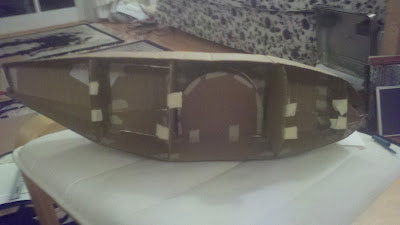
Laminating the wheel box

Joost has laminated the heavy loaded parts of the wheel box on both sides. He used 160 grams glass fabric ('keper') and epoxy resign. By applying glass on both sides of the plywood Joost has created a sandwich panel: Very strong stiff, and light. I like the idea that we can reinforce heavy loaded parts of the body in this very simple and effective way.

I think Joost will get the plywood velomobile on the road next week! I have bought a QuestXS and we plan to compare the aerodynamics of both velomobiles. For me the QuestXS is a very nice alternative for commuting. The shape is very nice but she is rather heavy (34 kg). I wonder how much less the aerodynamics of the plywood velomobile is. The plywood velomobile weighs 23 kg only.

Developing the plywood velomobile is a lot of work. I try to involve others into the project. Let me know if you are interested.

sanded

making a pattern


one hardly sees the laminated portion

here you also see there is no connection along the chain: the body is strong and (almost) stiff enough without it


Monday, 18 March 2013

Joost is fixing the body

My new colleague Joost is fixing the body. Together we have glued the broken parts as good as possible and with remarkable success. Joost will laminate glass fabric on both sides. Laminating the plywood on heavy loaded places is a very simple and effective way to reinforce the body.


Monday, 7 January 2013

Darin Wick

Look what Darin Wick has made! I like the short seal like tail. Contrary to my design of the plywood velomobile (or better the design of Bart Verhees) in Darins design the seams are in the longitudinal direction. The effect is beautiful lines but a lot of work to connect them. Quest-style closed wheel boxes are easy to imagine too. Darin published a python script to plot the parts.

1 to 5 model copied from Darins website
https://lh4.googleusercontent.com/-MgGWIIZ389E/Tt5_haHEGDI/AAAAAAAAA3s/4CYaZJrOh-4/s400/2011-11-20_21-51-47_902.jpg
inside

Tuesday, 9 October 2012

break down!

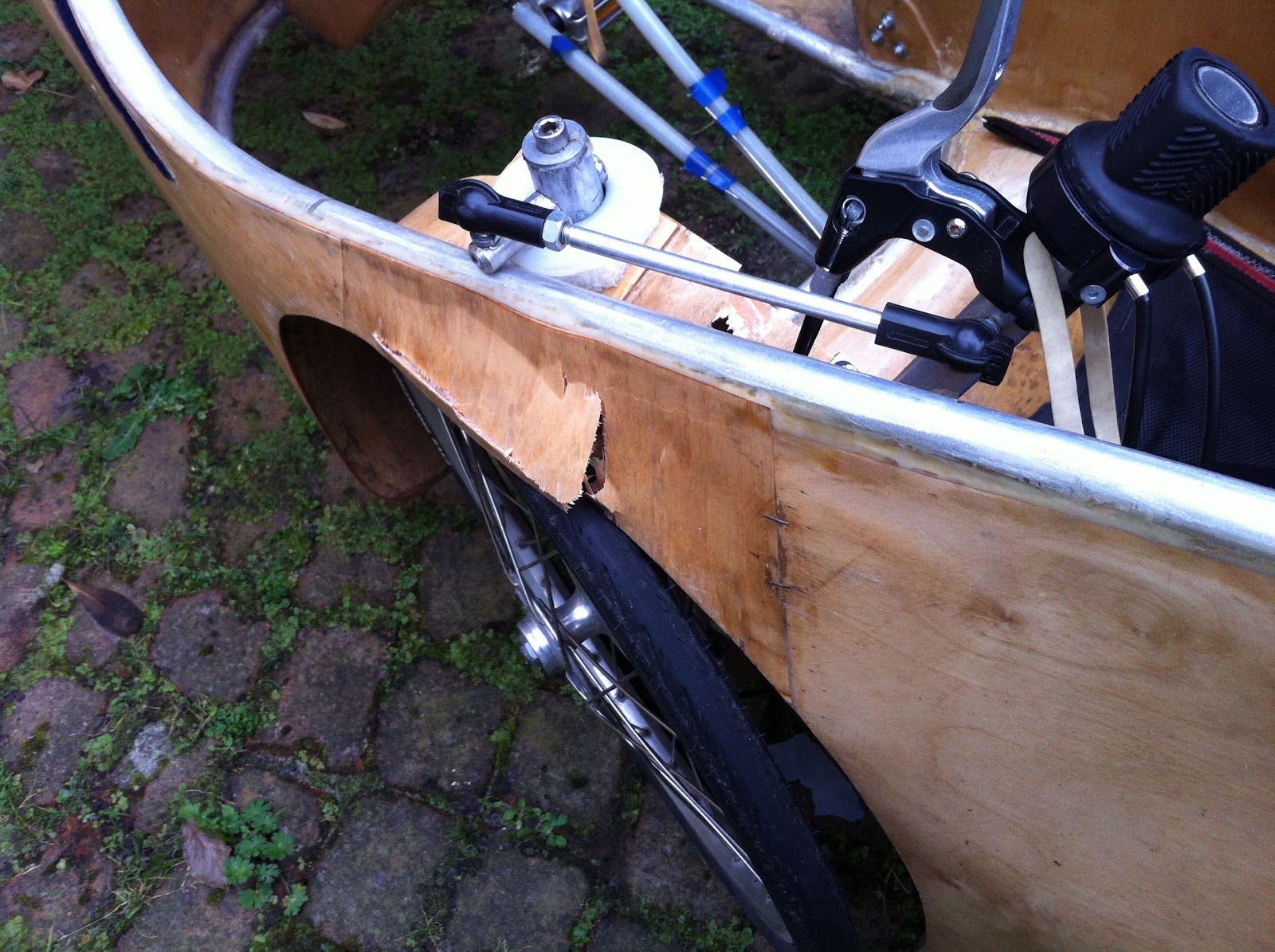
This morning the body failed. Yesterday I stiffened the spring. While taking a put hole the spring support broke. The connection to the circular sheet in front was cracked a few weeks ago. I should have done something about it then....
The connection in front was failed already a few weeks ago.

When the spring lost support the wheel damaged the body.


Monday, 8 October 2012

PU foam spring failed

The PU foam spring of the left McPherson strut was failed. The right side is ok. It could be the material is degraded after 20 years. Maybe the wall thickness is too small. The cylinder shape buckles outward. Every time I take a right turn the wheel touches the wheel box. I have fixed it today by wrapping cotton tape around it to prevent the cylinder from buckling.


The recess on top fits in a hole in the wooden body. A aluminium tube glides in this 'bearing'.


Saturday, 6 October 2012

rear light

In June I started a new job at Holmatro in Raamsdonksveer 20 km from were I live. I never planned to use the prototype of the plywood velomobile for my daily commuting but the delivery time of a Quest XS is 6 months... It 's no use to order one as it will arrive in the spring.

In the summer I used my MTB but now the wetter is getting poor I'm forced to use the prototype. I must have travelled overr 400 km now and without structural problems (apart from a broken seat hook and a chain that sprung of the idler wheel). I see some cracks here and there but nothing serious (I think). The prototype was designed on the edge (and over it here and there) to learn. I have mixed feelings when I drive over a rough road with put holes in the morning. The idea of having to call my new colleagues when I'm stuck is worrying me. But so far so good...

What I don't like: getting in and out is a burden. The chain is noisy. The Rohloff is very noisy in low gears (it is directly bolted to the monocoque). The velcro of the tent isn't strong enough, the seat is just a piece of cloth hanging like a beach chair and this gives little support to my middle back. I improvised with little hooks here and there and it is very irritating that I get hooked too now and then. When I take really hard turns the steering get uncontrolled a bit. Sometimes the chain tube bounces to the right crank. I enlarged the front wheel box at the right side because the wheel would hit it while steering. The left spring is too soft and in right turns the wheel hits the top of its box (~ 2 mm has been grinded away already!).

It is getting dark in the morning so I have installed a LED rear light. I use a head light too. Hope I'm visible now.
LED rear light. Nice looking place but I expect it will become very dirty when it rains...
Johan Goosens called me and mentioned there may be interest from Belgian high schools in the plywood velomobile project. I really hope this design inspires other people. There is a lot to be improved.