Thursday, 17 May 2012

S Eco Marathon

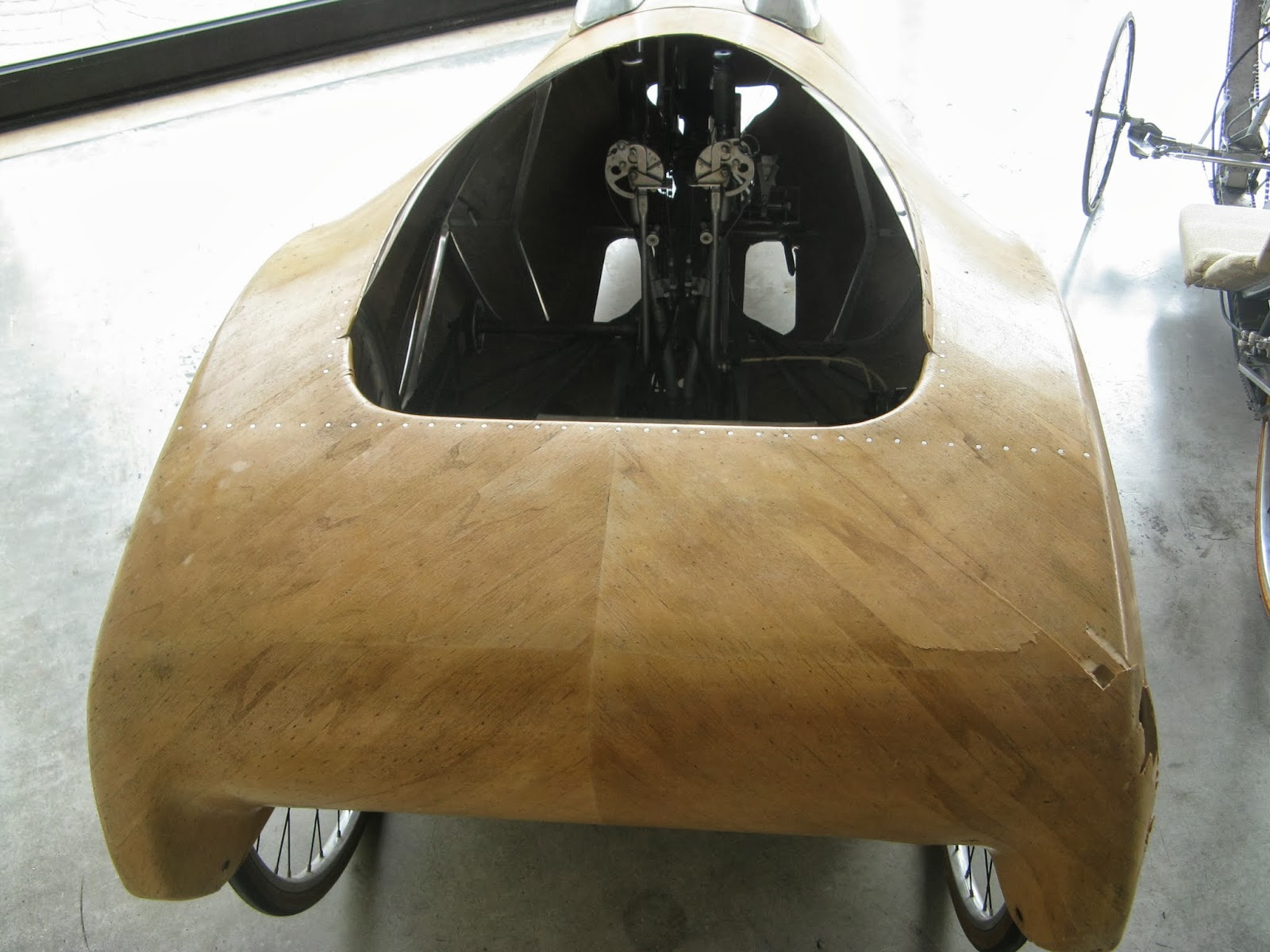
Today I visited the S Eco Marathon in Rotterdan. 3000 students united in 200 teams trying to get as far as they can on one liter gasoline...  It was a great pleasure to discover that the winner of the 2003 competition was a wooden monocoque. It was a team of the St Joseph La Joliverie from Nantes, France. They reached 3103 km. Come to Nantes this summer

The 2003 winner LPTI St Joseph La Joliverie

The 2003 winner LPTI St Joseph La Joliverie

detail of the wooden body

Sunday, 8 April 2012

Summer lab à Nantes

Check this out: July 23 to 28 plywood velomobile summerlab and this too in Nantes.

Please let me know if you are coming to build your own plywood velomobile. Provided enough people come I will be there and bring my proto.

The second proto of a plywood velomobile

Friday, 9 March 2012

K-drive

The HPTeam Delft and Amsterdam  choose the K-drive to improve their machine. This video shows the K-drive. I found this redesign on the web. I like the toothed belt: light and clean.

LucaBike redesigned the K-drive

Saturday, 28 January 2012

On mass and aerodynamics

Is there a trade off between mass and aerodynamics? A streamlined velomobile may reach a higher speed at the same power input because of the decreased aerodynamic drag but the fairing adds extra mass to the vehicle. Is there a speed penalty in adding mass? The rolling resistance of the wheels will increases but also the time and energy needed to accelerate the vehicle. While setting a new hour record only the first minutes are used for increasing the speed. But in normal every day traffic we may have to stop every km...
I calculated the total trip time for a 5 km trip and varied the number of starts. In the next diagram you find the total trip time and the maximum speed for different vehicles. The coefficient of rolling resistance was held constant at 0.005. The QuestSL is a Quest with the mass of an MTB. For the calculation of the plywood velomobile I estimated the effective area to be equal to that of the Versatile. The mass of the Plywood Velomobile was very optimistic chosen to be 18 kg (The current proto is 23 kg).
.

I assumed a cyclist that delivers 75 W power. At that level the MTB would reach ~20 km/h which is more that the most of us do... We can conclude that at 7 starts in 5 km the Quest and the Plywood Velomobile perform equal. The mass reduction compensates for the compromised aerodynamic quality. At an increased cyclist power the break even point moves to the right. 7 starts in a 5 km trip is quite high but not unrealistic for an urban trip. 
All in all we can conclude the most apparent difference exists between the MTB and the other vehicles. The differences between the velomobiles are small. It would be interesting to see what happens when a small slope is taken into account. Another interesting thing is recuperative breaking and start assist.

On second thougth: After a 5 km trip in a Quest with one start only the total work done is 48.2 kJ. The Quest reaches a maximal speed of ~42 km/h after 3.5 minutes. The kinetic energy of the vehicle and rider at 42 km/h is ~7 kJ. Now it becomes very clear what happens when we have to stop and accelerate again: we loose the kinetic energy of 7 kJ which is 7/48=15 % of the energy needed with one start only. Would we have to stop 4 times our energy usage more than doubles ! The MTB uses 104 kJ for the 5 km trip with one start only.  His kinetic energy reaches 2 kJ only (2/104= ~ 2%). An extra stop doesn't bother him to much... 
Depending on the number of starts in our trip, recuperative breaking and start assist would give a significant increase in performance of the Quest...

Wednesday, 18 January 2012

Cycloid drive


video
Miles Kingsbury reports a 90% efficiency on his cycloid drive:

"We have also found that although the drive is mechanically very efficient, physiologically it was not so good. We did a number of tests and found it was only about 90% as efficient as a circular drive. In the end we decided this inefficiency was caused because the main leg muscles were performing a 50% duty cycle compared with only about half that on a circular drive. Although it seems that this higher duty cycle should help efficiency, it doesn’t allow the muscles to recover and get rid of lactic acid build up, causing a severe burning sensation! ".

I will try to make a multi body analysis of this drive. It may be the problem is the kinetic energy of the thigh, calf and foot at the extreme positions. The cyclist has to do work for decelerating and accelerating his legs at the returns.

A page of Human Power, the technical journal of the IHPVA issue Volume 8 No2, spring 1990

Saturday, 14 January 2012

Lineair drive

The conventional pedal rotates around the crank axle. In a velomobile with rotating pedals the feet are not only moving in driving direction but also up and down. Should the up and downwards motion be done away with the nose of the velomobile could be much lower. That may improve the aerodynamics of the body.

multi body of a human leg
Instead of a rotating crank we could use an oscillating crank. The pedals would move for and backwards while the crank rotates 60º only. The cranks could be connected via 2 sprag clutches to the wheels. But than the pedal speed would be almost constant. Only at both extreme positions the pedal speed would have to change very fast to the opposite direction. Is that comfortable and efficient?
motion of center of gravity of thigh, calf and foot [m]
To get an impression about the losses that could be created I calculated the kinetic energy of the thigh, calf and feet of a human leg while driving the lineair drive. At the returning positions they are 2 and 5 Joule. The last value is when the leg is stretched. Humans (animals too) are able to optimize their motion. It could be that we would stretch out our foot in the last phase to reach the most stretched leg position. In that case the kinetic energy of the thigh and calf would be recuperated. I think this is what we do while we are running.
kinetic energies Et: translation, Er: rotation
But in the most pessimistic approach all kinetic energy would get lost: 7 Joule at every stroke. At a normal frequency of 1.5 Hz that would amount up to 2*7*1.5=21 Watt. That is an enormous  amount. A normal bicyclist produces 75 to 150 Watt! It may be that the foot motion has to be decelerated and accelerated in a controlled way at the returns. This kind of loss may exist in the rowing bike too. Is there anyone out there who has done experiments with lineair drives? Paul Jaray developed a similar drive in 1920. Miles Kingbury developed an interesting alternative: the K-drive. The Human Power-team is experimenting with it too.

Thursday, 5 January 2012

CFD with OpenFoam

I'm going to resume my CFD studies again. A few year ago I found a fantastic open source CFD package: OpenFoam . The learning curve is quite steep for a dummie like me but I was able to simulate flows with low Reynolds numbers (Re). A study of high Re flow around a velomobile is something completely different:
  1. I have to learn more about fluid dynamics
  2. I have to learn to use the OpenFoam snappyHexMesh tool to create a mesh.
  3. I have to learn to use an model that can describe turbulent flow (Reynolds Averaged Simulation).
I 'm not sure about this but it could be that a report on how I tackle my beginners problems are useful to you. You will find my report here