 | ||
| Paddy climbs into the velomobile. (The packing tape over the nose holes reduce the ventilation. With open holes it gets to draughty when its cold) |
Sunday, 9 January 2011
Paddy makes his maiden ride


Saturday, 8 January 2011
Wind and speed
Today I went for a short (10 km) test trip again. I improved the chain guidance with a long polyethylene (plastic shopping bag) tunnel under the floor of the body. Works great. No friction, no noise. At least until the packing tape fails... Than the chain springs of the rear chain wheel easily.
But what fun it is in a T-shirt only on a cold windy day driving on a dike. Catching the wind, sailing.The feeling that you are pushed aside. It was really drifting ! I have to get a speedometer.
I saw the nose flexing due to the load of the crank axle. I think this can be eliminated by closing or stiffening the little nose holes. Lots of other little nuisances: The brake cable is not mounted right, in a sharp right turn it brakes. The soft top comes of because the velcro is not strong enough. The Rohloff hub sometimes fails. The front suspension is too stiff.
But all in all I should be very happy with the results so far.
But what fun it is in a T-shirt only on a cold windy day driving on a dike. Catching the wind, sailing.The feeling that you are pushed aside. It was really drifting ! I have to get a speedometer.
I saw the nose flexing due to the load of the crank axle. I think this can be eliminated by closing or stiffening the little nose holes. Lots of other little nuisances: The brake cable is not mounted right, in a sharp right turn it brakes. The soft top comes of because the velcro is not strong enough. The Rohloff hub sometimes fails. The front suspension is too stiff.
But all in all I should be very happy with the results so far.
Friday, 31 December 2010
Front axle
 |
| McPherson wheel suspension |
In the first comment on this post Bob Stuart, the designer of The Car-Cycle X-4,
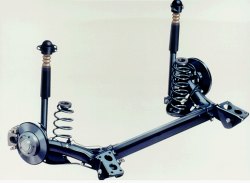
argues that the McPherson is one of the lightest options. In our design of a micro electric car (Elite) we used an alternative construction. It is a sort of torsion beam suspension. Because the distance between the wheels is so little, this construction may be lighter than the McPherson. Another advantage is that it incorporates the anti-roll function.
 |
| This drawing shows the wheel suspension of the Elite micro electric car. It was mounted to the body via silent blocs |
The McPherson construction distributes the wheel load over six distant points on the monocoque. Large torque loads will be transferred as small forces in these points (braking, cornering). This seems all very beneficial but the McPherson construction urges us to strengthen the monocoque at places where we really don't need it to be strong at all, would we not have this suspension. When we use a McPherson suspension we are forced to add material at the mounts of the longitudinal arms and vertical columns. We also have to increase the lateral rigidity, for instance with an u-frame between the front wheels. This may increase the body mass. The torsion beam axle connects to the monocoque at the front side of the seat. This is a place where we need it to be strong and stiff anyway...
 |
| Torsion beam suspension |
About mass
 |
| Mass distribution of the first prototype. Total mass 27 kg. |
Mike Burrows Windcheetah, the archetype of a tadpole trike, is 15 kg. Based on my figures this would mean that Mike uses 5,4 kg for frame and seat. In the first prototype 3,5 kg is used for wheel suspension which the Windcheetah doesn't have. We can conclude that a velomobile of 23,6 kg is still 23,6-15-3,5=5,1 kg too heavy. Although one might argue that the mass of a coat and two bags should be added to Mike's (beautiful) design...
Wednesday, 15 December 2010
On the road !
 |
| Until I've got a better picture this will do. The black cover is fixed temporarily. Lots to be done but I can ride it ! |
I will sum up the main specs and add a better picture as soon as the weather allows me to take one: Two front wheels with McPherson suspension, one unsprung wheel with Rohloff 14 speed hub behind. Two side sticks for steering. Monocoque body (No frame inside!). Drum brakes in front wheels. Size: 2750x720x750 mm (LxWxH). Cost estimation: 300 euro (body materials only). Total mass 23.6 kg.
 |
| 23.6 kg is very competitive... |
Sunday, 29 August 2010
The kit
 |
| The first prototype is inspected just after the arrrival at Boulogne Sur Mer |
When the design is finalized, I will describe the d.i.y. kit that may be available then. It will consist of laser cut plywood sheets an bent aluminum tubes. The rest is up to you.
The body
 |
| Paulus van Staveren build this body of a rear steered velomobile. |
The aerodynamic drag of developable shape may not be as low as that of a free formed shape. This is the compromise that I make to simplify the building and reduce the body mass.
I developed the sheets of my first velomobile with both a 1:5 and finally a 1:1 model. I simply wrapped paper sheets around curved panels. But this job can be done with a computer model too (for instance with the 3d surface modeler Rhino). I even developed a computer program in Matlab to do this. There is specialized software for hull design: Pilot3D, Delftship.
Subscribe to:
Posts (Atom)